

When something isn’t right at work, HR is usually the first place people think of, and often it is the right place. But not everyone feels able to start there. Understanding why helps explain where an external Personne de Confiance en Entreprise (PCE) fits: alongside HR, not instead of it.
The important role HR already plays
HR teams do much more than run formal processes. They advise managers, support employees day to day and resolve many concerns informally, alongside policies, contracts, performance, recruitment and the formal handling of complaints. When an employee needs a formal outcome, such as a grievance investigated, a policy applied or a working arrangement changed, HR is the right channel.
So when might someone hesitate to start with HR?
Even in organisations where HR is approachable and trusted, approaching HR with an issue can feel like a bigger step than the situation seems to call for.
Maybe the concern involves the person’s manager, or someone more senior. Maybe it is a tense working relationship that hasn’t become a formal issue, and they don’t want to make it one before they have thought it through. Maybe they aren’t sure whether what they are experiencing “counts”, or whether it is serious enough to raise. Maybe they worry about how speaking up could affect their reputation, their team or their career. Or maybe they simply want to talk it through first, understand their options and decide what, if anything, to do next.
These are common, human hesitations. And when there is nowhere to take them, concerns can stay unspoken until they grow into something harder to resolve: a formal dispute, a prolonged absence or a resignation that could have been avoided.

What a PCE offers
An external PCE is an independent, impartial and confidential point of contact outside an organisation’s reporting lines. The Swiss PCE associations describe the role in similar terms: écouter, accompagner, orienter – listening, supporting and guiding.
In practice, an employee can describe their situation to someone with no hierarchical relationship to them, clarify what is happening and explore possible ways forward, before deciding whether anything formal needs to happen at all.
Conversations with a PCE are confidential according to the profession’s codes of ethics. And so how to move forward is entirely the employee’s decision. Sometimes that leads to a conversation with HR, better prepared and clearer about what they need. Sometimes it is a different way of addressing the matter. And sometimes simply talking through a situation and the options is enough.
When HR is the right route
A PCE is not a substitute for HR, management or occupational health, and some situations clearly call for the organisation’s own channels: contractual and payroll questions, complaints that need investigating, adjustments that need implementing, processes that only HR can run. Part of the PCE role is helping employees recognise when a situation calls for that route, and supporting them as they prepare for it..
How the two work together
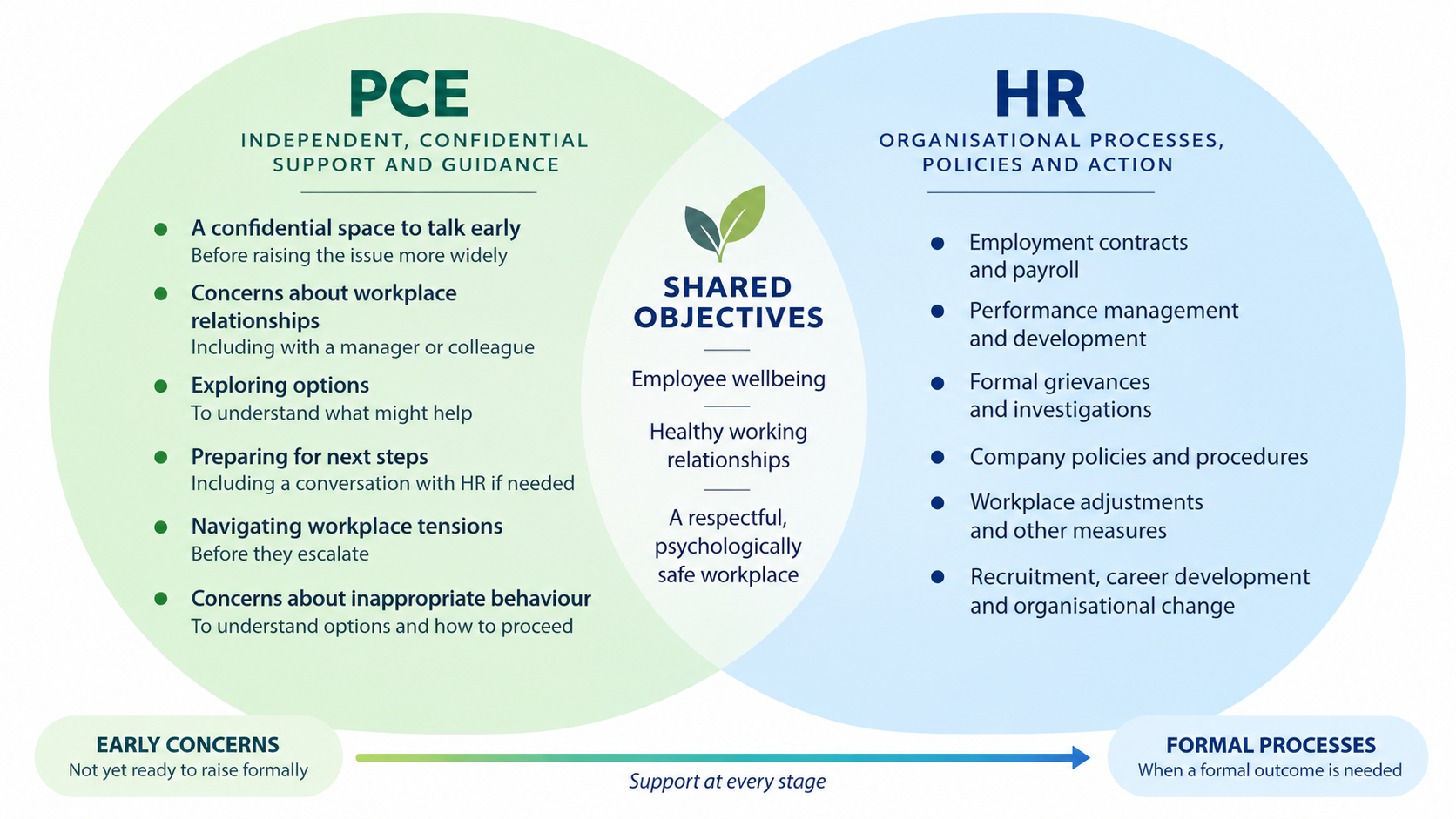
Seen this way, the question isn’t “PCE or HR?” but how each plays its part. HR provides the structures every organisation needs. A PCE adds an independent, confidential avenue that can help concerns surface earlier, when they are often easier to address. A conflict talked through early may never become a formal dispute. An employee with somewhere safe to go can get support before reaching crisis point.
For organisations, this complementarity matters. Article 2 of Ordinance 3 to the Swiss Labour Act requires employers to take the measures necessary to protect both the physical and the psychological health of their employees. Offering both strong HR support and an independent PCE service is one way of making that responsibility work in practice.
The language factor
For international teams in Suisse romande, there is one more consideration. When someone is already dealing with something difficult, having that first conversation in English can make it easier to express themselves and clarify and articulate their concerns before taking the first steps.
So when would an employee speak to a PCE rather than HR? Often at the moment when they are not yet ready to raise something more widely, but should not have to carry the situation alone. The two roles work best side by side: HR as the backbone of people support, a PCE as a trusted, confidential space where concerns can be heard early.
#PCE #WorkplaceWellbeing #HR #PsychologicalSafety #SuisseRomande #EmployeeWellbeing #Prevention