
Too often, conversations about psychosocial risks begin only once someone is already showing signs of serious strain at work. By then, the situation may have been affecting their wellbeing for some time.
First, what do we mean by psychosocial risks?
SECO, the Swiss federal centre of expertise for core economic policy issues, describes psychosocial risks as risks arising from unfavourable work organisation and a poor social working environment, which can have negative psychological, physical and social consequences.
These risks are linked to the way work is designed, organised and experienced. They can involve workload and work intensity, working hours, autonomy, emotional demands, relationships, recognition, values and organisational change.
They can affect our mental, physical and social health. The impact depends on factors such as the type and intensity of the strain, how long it lasts and individual circumstances.
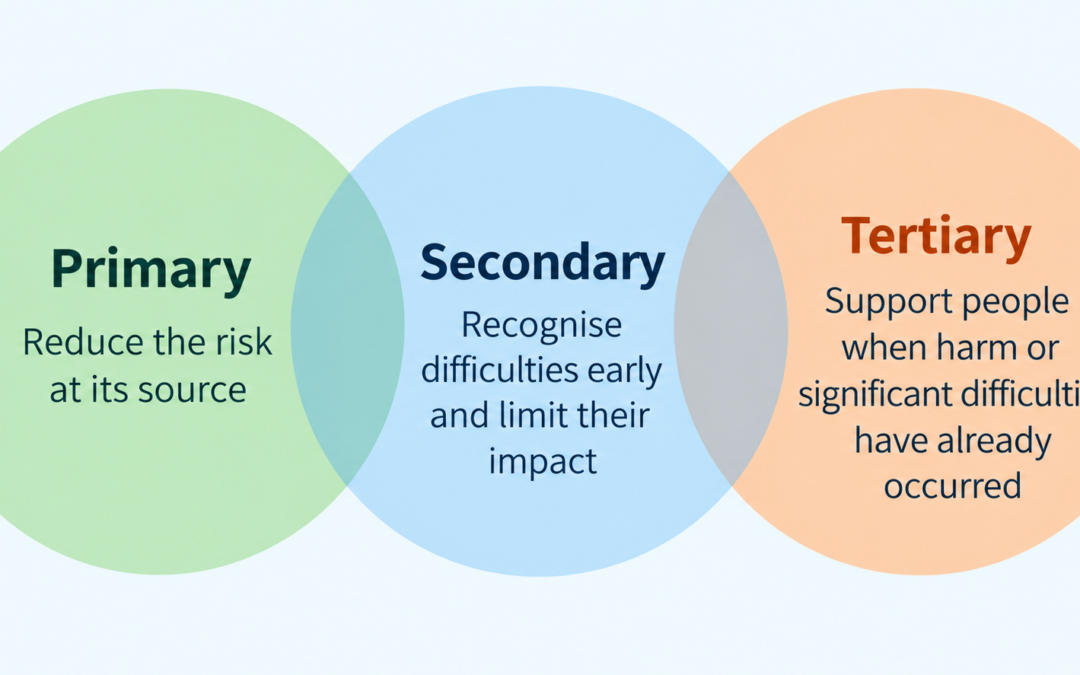
Effective prevention means addressing the causes, recognising difficulties early and supporting people who are affected. The priority should be to prevent or reduce risks at their source. The three-level framework described by Santé Travail FP offers a useful way to understand how these approaches can work together.
1. Primary prevention — organisational-level action

Primary prevention aims to stop psychosocial risks from arising in the first place. It starts by looking at the workplace and asking a few practical questions:
- What is creating the risk?
- Is the workload realistic?
- Are roles and responsibilities clear?
- Do employees have enough autonomy, resources and support?
- How are organisational changes managed?
- Do relationships and communication help foster a healthy working environment?
The focus is on the organisation and working with leadership to assess and improve the conditions in which people work, rather than placing the responsibility solely on individuals.
Measures can include identifying psychosocial hazards, improving work organisation, establishing a charter that prohibits harmful practices and promotes healthy working conditions, and training managers and employees to help recognise and reduce risk factors.
2. Secondary prevention — identify and respond early

Even when an organisation is committed to addressing underlying risks, difficulties can still arise. Secondary prevention aims to identify those concerns early and limit their impact.
Managers and employees need to be able to recognise warning signs and know what to do when they emerge.
Measures may include awareness-raising, stress-management training, manager training and development, and clear systems for detecting, reporting and addressing violence or other psychosocial risks.
The aim is not simply to react once a situation reaches crisis point – it is to act before the situation escalates.
3. Tertiary prevention — support, recovery and corrective action

Sometimes the effects of psychosocial risks have already had a negative impact. Tertiary prevention focuses on supporting those affected, reducing the impact and helping them recover and ideally get back to a healthy working situation.
This may involve psychological support, return-to-work measures, monitoring absences, opportunities to discuss and debrief difficult situations, and adjustments to working arrangements where appropriate.
At this stage, the focus is on managing the consequences of the situation and supporting the person concerned, while also considering what needs to change to prevent a recurrence.
The three levels work together
These approaches are not separate programmes. They complement one another:
- Primary: How can we reduce risks at their source?
- Secondary: How can we recognise difficulties early and limit their impact?
- Tertiary: How can we support people when harm has already occurred?
At the heart of this approach is the idea that psychosocial risks are not an individual issue. They can stem from work organisation, working conditions and workplace relationships. Employers therefore have a responsibility to prevent and manage them (as laid out in Article 6 of the Swiss Federal Labour Act, and in Article 2 of Ordinance 3 to the Labour Act, supported by Article 328 of the Swiss Code of Obligations).
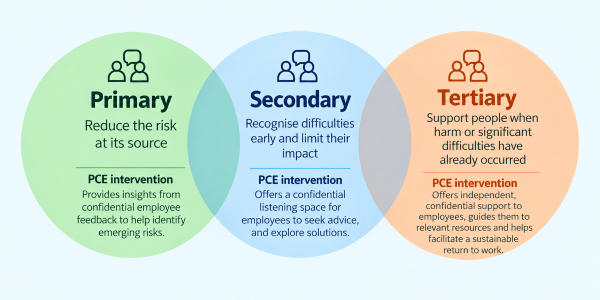
This is where a Personne de Confiance en Entreprise (PCE) can complement an organisation’s wider prevention approach at all three levels.
- At the primary prevention level, a PCE can offer awareness seminars on psychosocial risks, respectful workplace relationships and available support services, as part of the onboarding of new employees and managers or ongoing internal awareness initiatives.
- At the secondary prevention level, a PCE can offer employees a confidential space to raise concerns, seek guidance, talk through difficult workplace situations and explore their options, helping them address issues before they escalate.
- At the tertiary prevention level, a PCE can support employees experiencing or recovering from difficult workplace situations, including by helping them reflect on their needs and options as they prepare to return to work or rebuild working relationships.
This support complements—not replaces—the organisation’s existing structure and strengthens its ability to identify, prevent and address workplace risks.
Ultimately, an effective approach to limiting the impact of psychosocial risks in the workplace is about having all three in place so you are well equipped to support your employees, whatever a given situation calls for.
#PsychosocialRisks #WorkplaceWellbeing #Prevention #MentalHealthAtWork #PsychologicalSafety #HR #EmployeeWellbeing #PCE